

The SEA-Mate® Blending-on-Board system enables the operator to produce Fit-for-Purpose cylinder oil. The system allows for a tailored cylinder oil BN to be adjusted and delivered. The performance of Blending-on-Board lubrica-tion is documented and well-proven on-board vessels.
Besides operating vessels with Blending-on-Board, it is also
important to understand the blended oil characteristics
compared to traditional cylinder oils. Laboratory analysis is very clear: Blending-on-Board cylinder oil is of equal or superiorquali compared to traditional cylinder oil, on a number of
critical parameters.
Questions have been raised as to the use of used system oil as a base oil. Actually, the combination of well-handled cylinder oil
additives and used system oil delivers very interesting and
beneficial cylinder oil qualities, since the system oil is used as a premium quality (or enhanced) base oil.
Laboratory results illustrate that the performance of Blending-
on-Board cylinder oil is always at the higher end of what can be expected. This better performance, combined with the technical flexibili that on-board blended cylinder oil allows when it
comes to defining the BN and the feed rate to be used, makes it superior.
As a basis for comparison, various BNs of Blending-on-Board cylinder oils were produced on various vessels using various
additive packages. is document summarizes the results obtained from standard laboratory tests that are used to assess cylinder oils.
When it comes to cylinder lubrication, the tendency of the oil to
form deposits and its abili to clean them is of the outmost
importance. ese deposits can be found on the piston crown
and also in the piston ring grooves. ey will eventually strongly
contribute to a third body abrasion phenomena that will
accelerate the wear of the liner, as well as the wear of the piston
grooves.
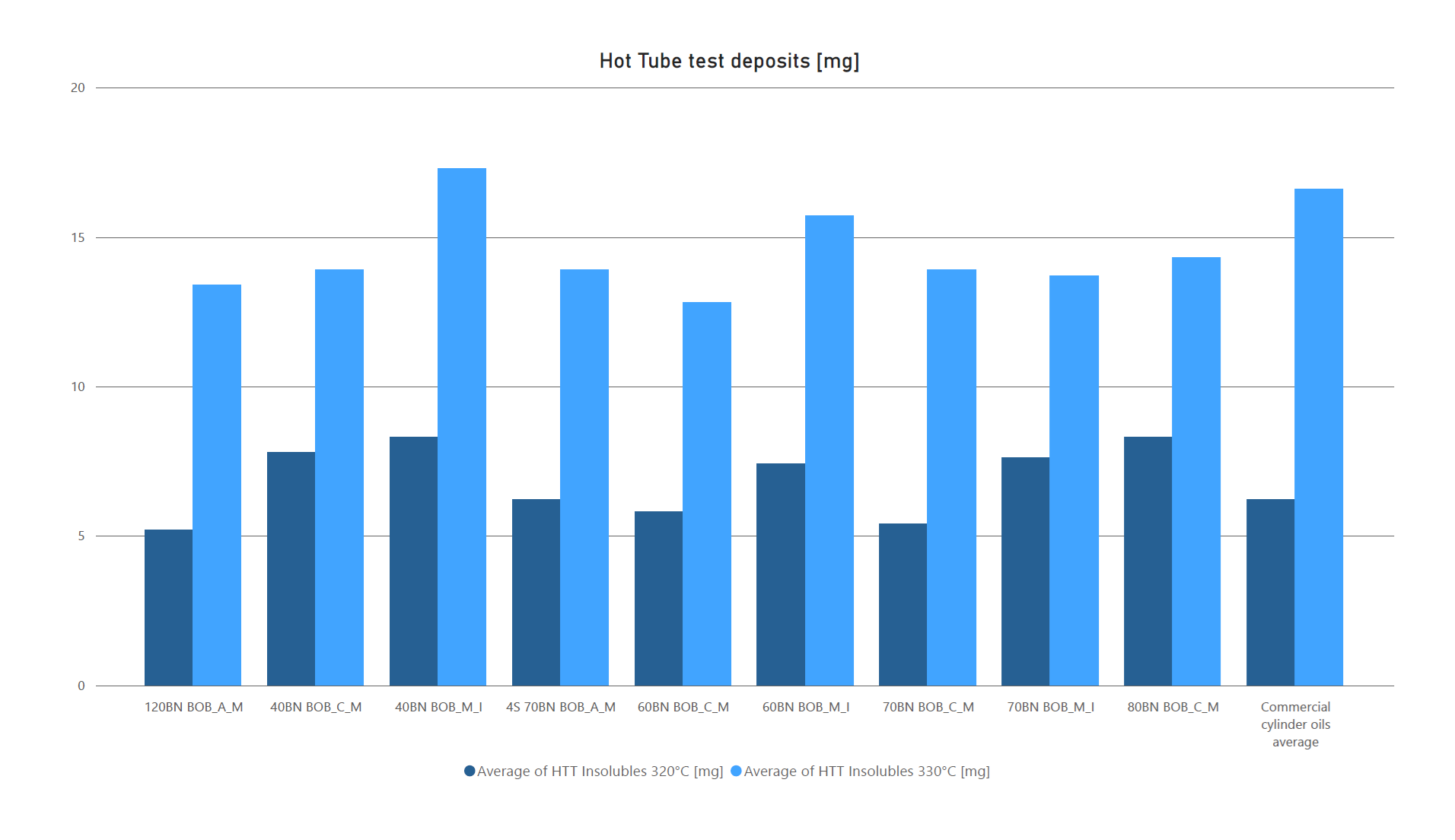
The Hot Tube test (also known as Komatsu Hot Tube test)
provides an indication of the control of cylinder oil deposits and detergency at high temperatures in an oxidative environment.
The result is expressed in terms of the quanti of deposits
created. e lower the quanti of deposits created, the better the lubricant is considered on that aspect. e Blending-on-
Board cylinder oil results consistently showed a smaller or equalquanti of deposits in the Hot Tube test.
It can therefore be concluded that when it comes to deposit control and detergency, the variable BN Blending-on-Board lubricant behaves at least as good as the classic, fixed BN cylinder lubricants.
Cylinder oil is subject to high temperatures and as a conse-
quence the lubricant molecules are submitted to thermal stress that they have to be able to withstand. Otherwise, the molecular
structure may be destroyed, the additives rendered inoperative,
the viscosi increased and acidic species created.
The cylinder oil must be able to withstand high temperature
oxidation in order to perform its main functions (oil film build up,
neutralization, detergency and dispersency). e pressure
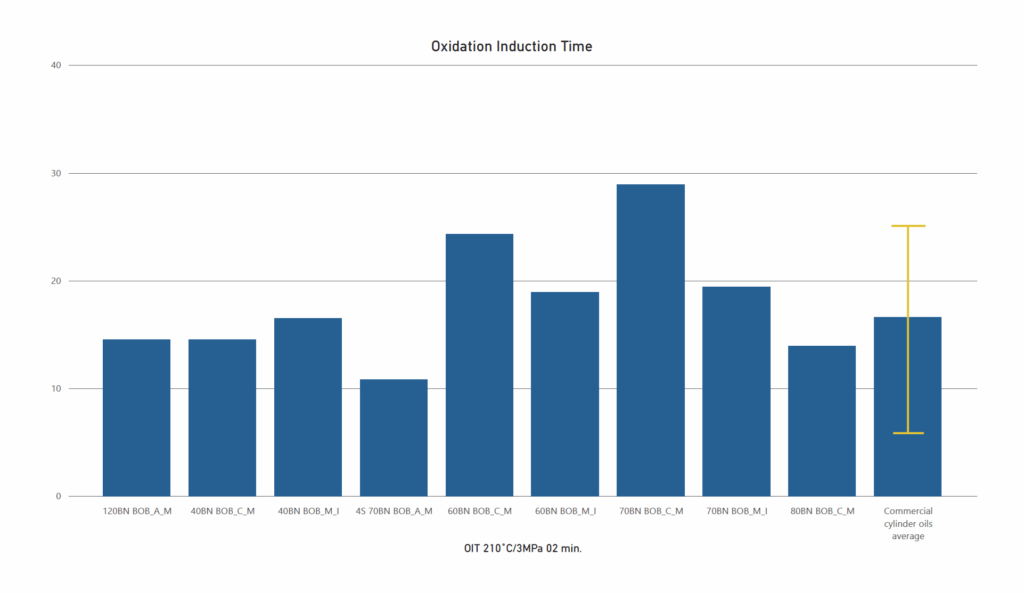
differential scanning calorimetric (PDSC) test assesses the
oxidative stabili of the various cylinder oils at high temperature
and pressure. e result, expressed in minutes, represents the
time the lubricant can resist oxidation at 210°C with a forced
influx of oxygen. The higher the oxidation induction time, the
better the lubricant is considered for its oxidation resistance performance.
The results in the table below compare various Blending-on-
Board cylinder oils (with various additives and BNs) with the average of commercial cylinder oils.
The results show that the blended cylinder oils exhibit at least an oxidation resistance comparable to the commer-
cial cylinder oils, and in some cases even better.
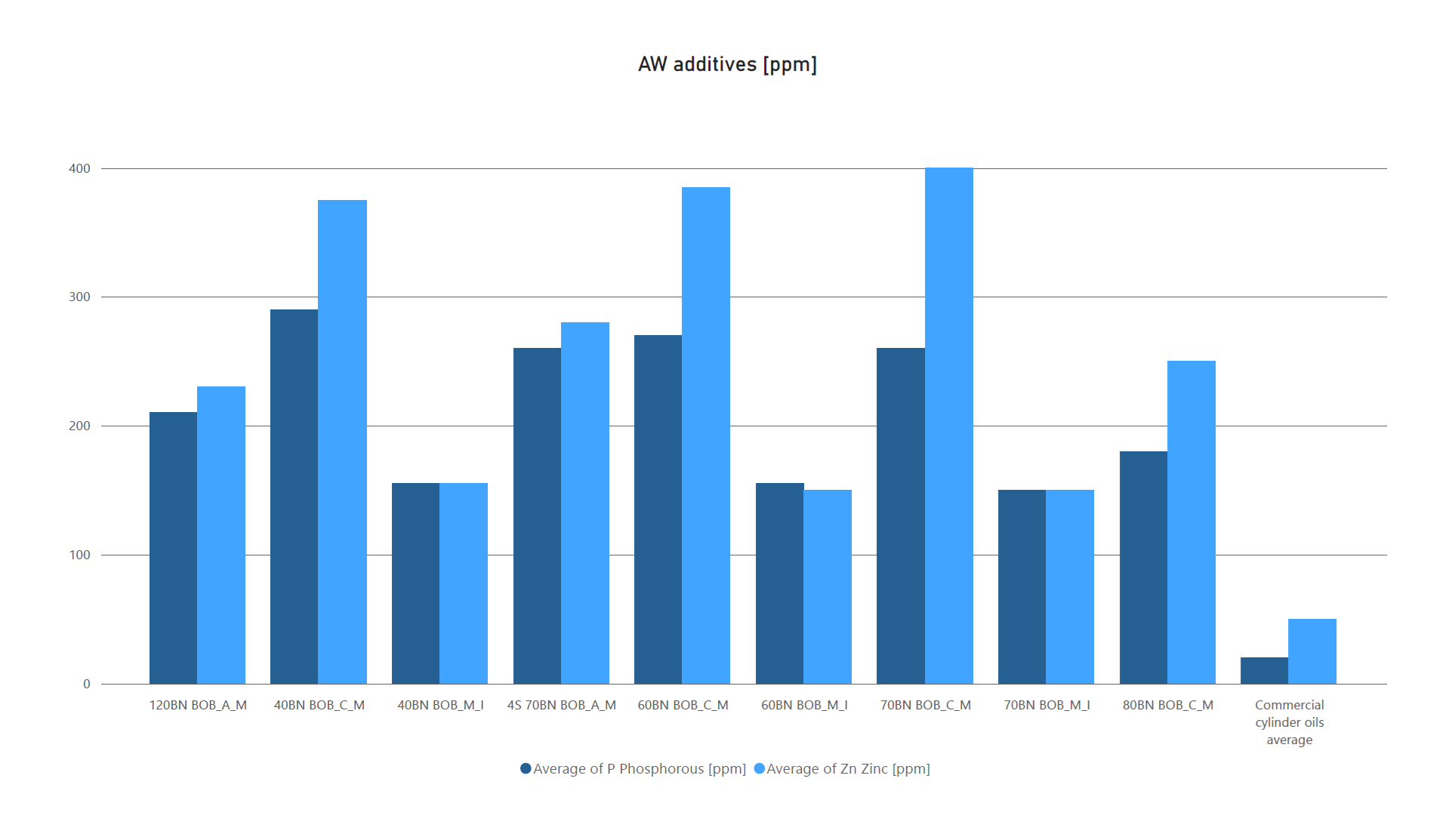
Interestingly, Blending-on-Board cylinder lube oil will always
contain anti-wear (AW)/Extremepressure (EP) additives, mainly
in the form of ZDDP (Zinc DialkylDithioPhosphate) or equivalent.
System oil, which constitutes the base oil in the blended
cylinder oil, contains a high quanti of those additives. As a
consequence, the wear resistance, as well as the load carrying
capaci of the blended cylinder oil, will be enhanced in
comparison to a standard cylinder oil with a classic group I or
group II base oil.
The unique presence of anti-wear additives in Blending-
on-Board cylinder oil has proven to be a performance-en-
hancing parameter during difficult operating conditionscand it reduces the risk of excessive or sudden severe wear.
Cylinder oil is meant to operate over a wide range of tempera-
tures, considering the temperature distribution over the lengthof the cylinder liner or the variation of temperatures depending
on the operating load.
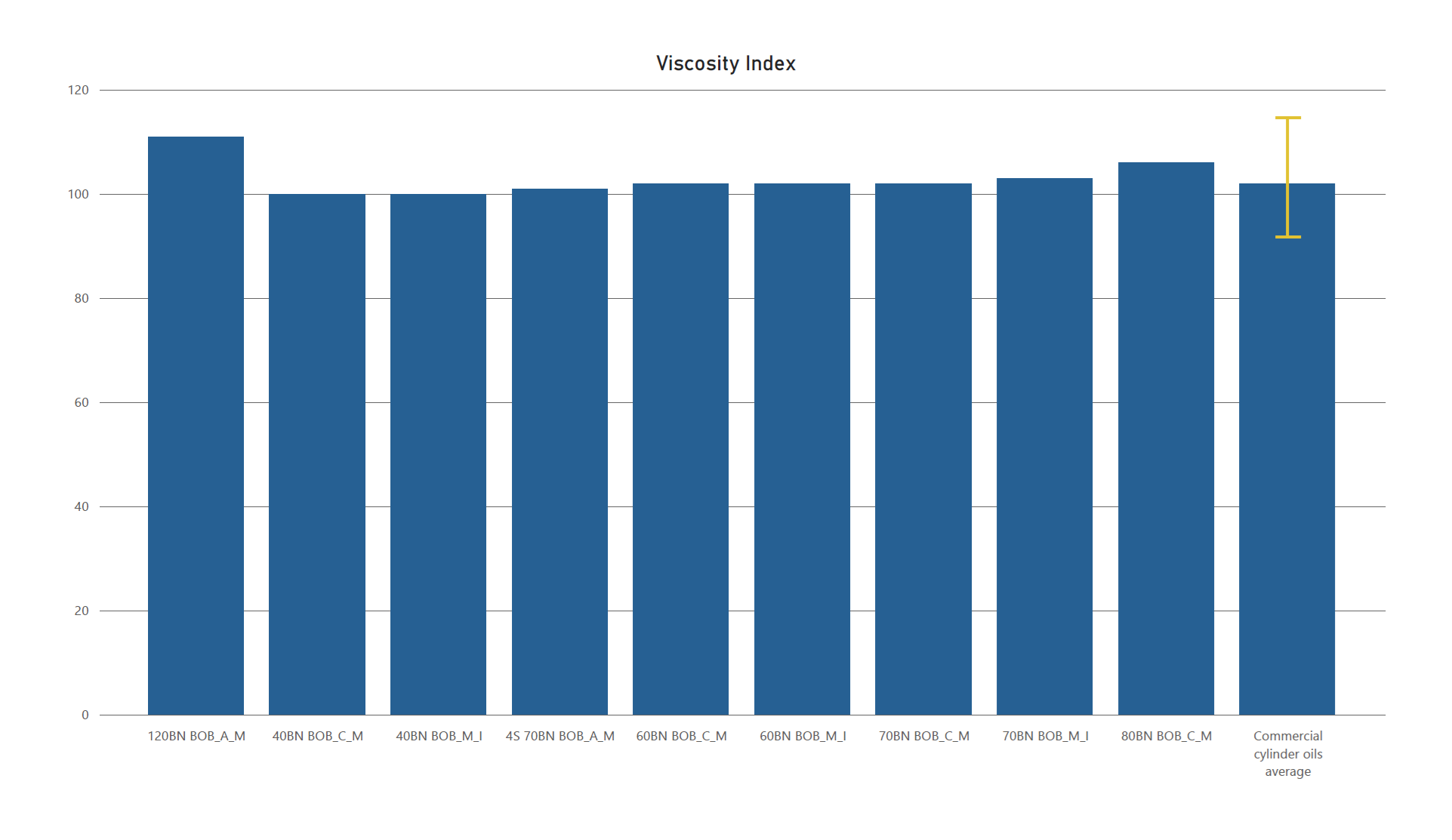
The viscosi index VI is used for the description of the viscosi–
temperature behaviour. e higher the viscosi index is, the less
the oil will degrade when the temperature increases.
The Blending-on-Board cylinder lubricant always exhibits
a viscosi index greater than 100 and is always as good
as or even better than standard fixed BN cylinder oils.
As Blending-on-Board operates with a variable BN cylinder
oil, the Blending-on-Board cylinder oil will have viscosities
ranging from lower SAE 40 to SAE 50. Although historically an
SAE 50 cylinder lube oil has been required, the use of these
SAE 40 to SAE 50 grades did not show any detrimental
effect during field operation.
Actually, this lower viscosi (that is still suitable for optimum
piston ring/liner contact) has an additional advantage: e
lower viscosi might improve the cylinder lube oil distribution
on the cylinder liner circumference, which is still today a big
challenge for the large bore 2-stroke engines and can lead to
irregular wear, also known as clover leafing.
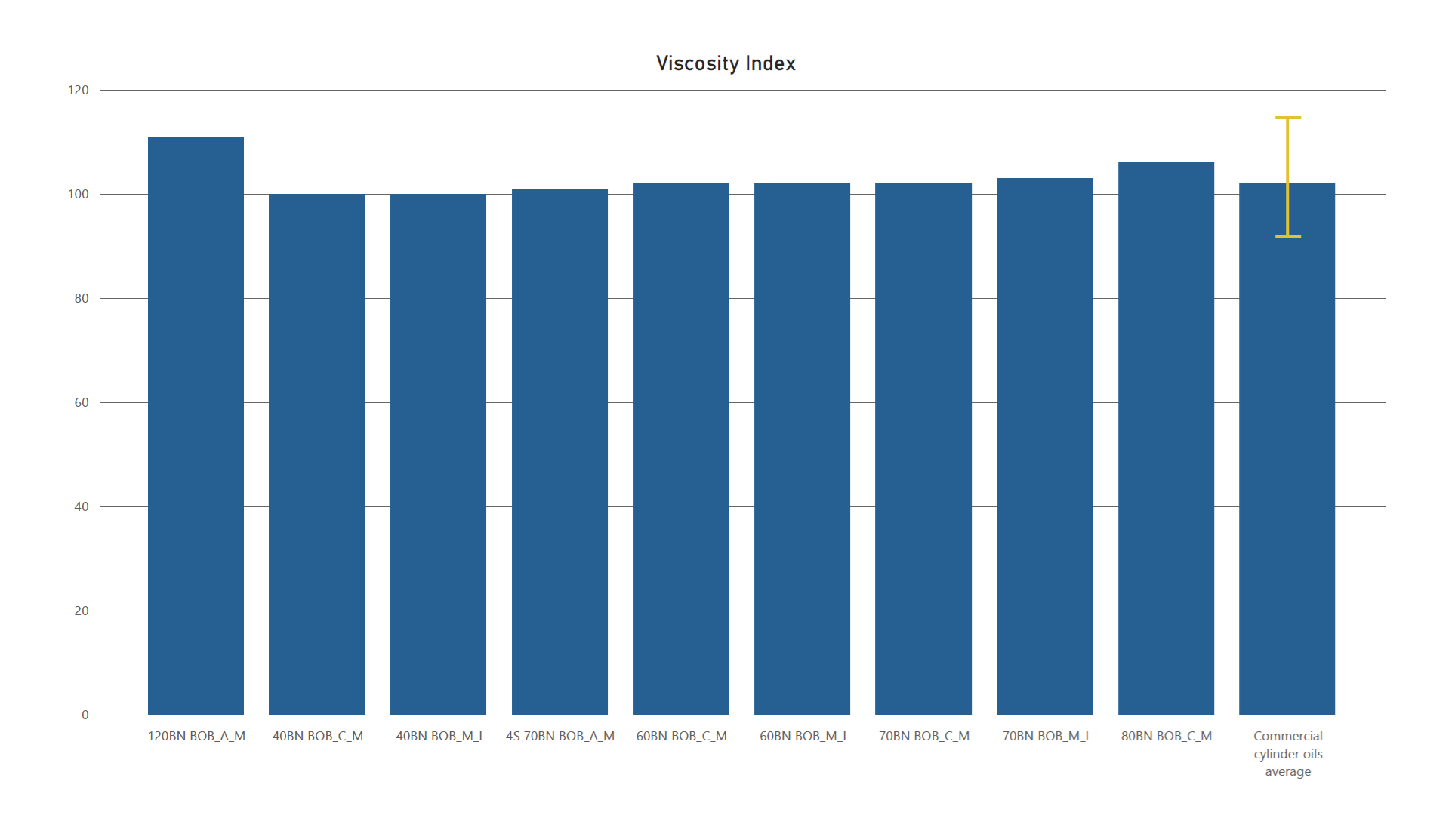
These results illustrate that the performance of Blending-on-
Board cylinder oil is equal to or better than the commercial cylinder oils average, on the following parameters:
The Blending-on-Board cylinder oil meets or exceeds
performance expectations and also offers a technical
flexibility when it comes to defining the BN and the feed
rate to be used, making it a superior choice.